
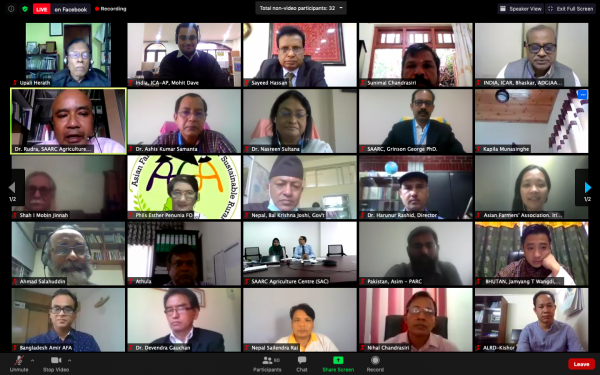
ICA Asia-Pacific (ICA-AP), in collaboration with the SAARC Agriculture Centre (SAC), Asian Farmers Association for Sustainable Rural Development (AFA), the Food and Agriculture Organization – Regional Office for the Asia Pacific (FAO-ROAP), and with the support of the ICA-EU Partnership[1] organised an online “Regional Consultation meeting on the UN Decade of Family Farming (UNDFF): Formulating Strategies and Action Plan to Strengthen Smallholder Family Farmers in South Asia”. The meeting was useful in providing direction to formulate a Regional Action Plan that defines the key priorities, strategies, and actions to implement the UNDFF in South Asia. The meeting was held on 5th and 6th November 2020 and was attended by around 150 participants from the government, family farmers organizations, cooperatives, academia, civil society, research institutions, and intergovernmental organisations from South Asia.
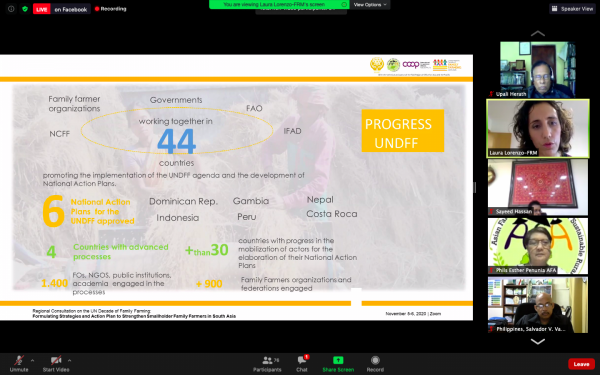
The government officials from India, Bangladesh, Pakistan, Nepal, Bhutan, Maldives, and Sri Lanka presented the situation on family farming in their respective countries, as well as on-going and planned efforts to make a national action plan for the UNDFF. Firsthand experiences from family farmers’ organisations from Nepal, India, and Sri Lanka in supporting the National Family Farmers’ Committees and multi-stakeholder dialogues were also shared with participants. Break-out group discussions were held to identify key priorities such as policies, actions, and studies/researches that need to be undertaken at the regional level and that will further support the development and implementation of a Regional Action Plan for UNDFF, anchored in the UNDFF Global Action Plan.
In the break-out sessions, the participants committed to pursuing the following priority policies, actions, studies, and researches at the national and regional level.
- Develop an enabling policy environment to strengthen family farming
- Support youth and ensure the generational sustainability of family farming.
- Promote gender equity in family farming and the leadership role of rural women.
- Strengthen family farmers’ organizations (FFO) and their capacities to generate knowledge, represent farmers concerns and provide inclusive services in rural areas.
- Improve socio-economic inclusion, resilience, and well-being of family farmers, rural households, and communities.
- Promote sustainability of family farming for climate-resilient food systems.
- Strengthen the multi-dimensionality of family farming to promote social innovations, contributing to the territorial development and food systems that safeguard biodiversity, environment, and culture.
The participants further committed to operationalising the UNDFF global action plan at the country level through the development and implementation of National Action Plans, led by inclusive, multi-stakeholder process (governments, farmers organization, civil society, research organizations, cooperatives and private sector). It was decided that the regional level will institute mechanisms for the formulation, implementation, and monitoring of the UNDFF plan both at the national and the regional level.
Lastly, the organizers committed to finalizing and packaging a Regional Action Plan for UNDFF in South Asia based on the results of this meeting that will be endorsed by SAARC leaders. Within the next two months, another multi-stakeholder virtual process will be convened to finalize this plan for endorsement by SAARC leaders. The participants called on their governments and international development partners to mobilize resources to support the implementation of South Asia’s Regional and National Action Plans for the UNDFF.
[1] In March 2016, the ICA and the European Union signed a Framework Partnership Agreement to implement a development programme aimed at benefitting and advancing cooperatives worldwide.


